Responding Together With A Circle of Support
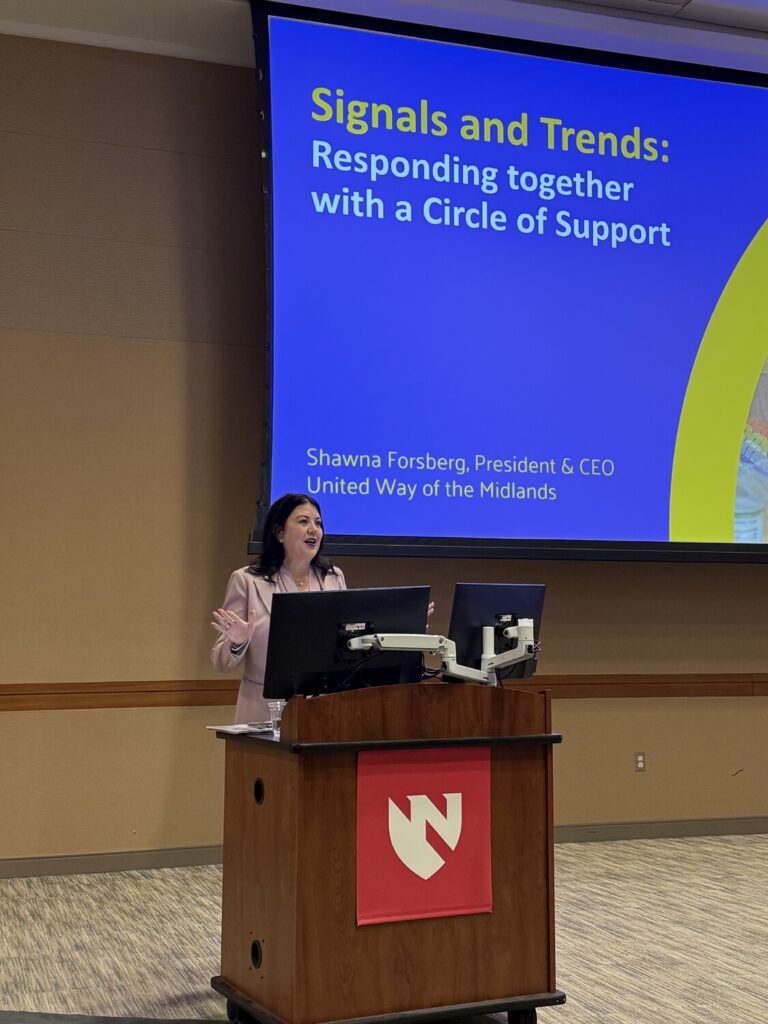
This blog reflects insights shared by United Way of the Midlands President and CEO Shawna Forsberg during a presentation to the Center for Chronic Illness Self-management & Prevention (CRISP) around Implications of Food & Financial Insecurity in Chronic Illness.
In our work, we talk with individuals and community partners every day about what they are seeing and experiencing.
When people in our community need help, many turn to 211 to find local resources.
Through those conversations, we hear directly from individuals navigating rising costs and difficult tradeoffs. Across our network of nonprofit partners, we also see those same pressures showing up in increased demand, longer wait times and growing complexity in the needs they are addressing.
At times, those broader trends come into focus through individual experiences.
One older adult recently described what it means to receive a fresh food box every two weeks from weeks from a partner funded by United Way of the Midlands. Each box includes fresh vegetables to cook, along with a few prepared meals. For someone managing a chronic condition without reliable access to transportation, that consistent access to food is essential.
“It means everything,” she shared.
What might seem like a simple intervention is something much more foundational. It supports health, independence and the ability to manage daily life.
And it reflects something we are seeing more clearly across our community. The way households are experiencing food has changed.

Over the past several years, the cost of food has increased in ways that many budgets have not been able to absorb. A grocery basket that cost $100 in 2020 now costs closer to $130. The increase was not gradual. It accelerated quickly beginning in 2021. And while inflation has slowed, prices have not returned to where they were. They have reset at a higher level.
That shift matters. The challenge is no longer temporary, it is ongoing.
For many households, especially those with limited or fixed incomes, this means constant adjustment. And in that adjustment, food is often where tradeoffs happen first.
When housing costs rise, grocery spending becomes more constrained. When utilities fluctuate, food budgets absorb the difference. When income is uncertain, consistency in nutrition becomes harder to maintain. These are not isolated decisions, but part of a broader pattern in how households navigate financial pressure.
Today, many families are living closer to the edge. Nearly 1 in 4 adults in the metro cannot afford a $400 emergency expense without borrowing or delaying payments. What once may have been a manageable setback, like a car repair or medical bill or higher utility payment, can now trigger a cascade of difficult decisions.
This is what instability looks like in real time. It is not always constant, but it is recurring. Families move in and out of periods of financial strain, managing episodes that disrupt progress and make it harder to regain footing.
In that environment, food insecurity is not just about access to a meal. It is often one of the first signals that something else is shifting. Budgets are tightening, tradeoffs are increasing and stability is becoming harder to maintain.
In our work, we talk with individuals and community partners every day about what they are seeing and experiencing.
When people in our community need help, many turn to 211 to find local resources.
Through those conversations, we hear directly from individuals navigating rising costs and difficult tradeoffs. Across our network of nonprofit partners, we also see those same pressures showing up in increased demand, longer wait times and growing complexity in the needs they are addressing.
At times, those broader trends come into focus through individual experiences.
One older adult recently described what it means to receive a fresh food box every two weeks from our partner. Each box includes fresh vegetables to cook, along with a few prepared meals. For someone managing a chronic condition without reliable access to transportation, that consistent access to food is essential.

Food costs rose sharply and remain elevated, while other essential costs have followed different paths.
Data across the Midwest reinforces this pattern. Housing continues to rise steadily. Utilities fluctuate and create unpredictable pressure month to month. Together, these trends create both sustained and uneven financial strain, making it more difficult to plan, absorb shocks or recover from disruption.
The impact extends beyond affordability. Food is deeply connected to the conditions that shape stability and health. Limited access to nutritious food can affect the management of chronic conditions, increase stress and disrupt routines that support well-being. Food insecurity rarely exists on its own. It is often a signal of multiple pressures happening at the same time.
Across the Omaha-Council Bluffs metro, nearly 120,000 individuals are currently experiencing food insecurity. One in four adults report difficulty affording fresh food. In some areas, access is shaped not only by cost but by transportation, proximity and availability. Even when support exists, it is not always easy to reach.
At the same time, the systems designed to respond are under strain. Nonprofit organizations are seeing higher demand while also navigating resource constraints. Some food pantries report receiving up to 15 percent less food even as more households seek support. A system that continues to respond is doing so under increasing pressure.
This is where coordination becomes critical. As needs become more complex and persistent, connecting individuals to the right resources quickly and effectively becomes more important. Access is no longer just about awareness. It is about navigation, timing and alignment across systems.
The 211 Helpline plays a central role in that connection.
As a free and confidential resource available 24/7, it provides a simple and trusted way for individuals to connect to support for food, housing, utilities and other essential needs. Specialists listen, assess each situation and connect individuals to resources that fit their needs. This reduces barriers, streamlines access and ensures people are not left to navigate complex systems on their own.
At the same time, 211 strengthens the broader network. Real-time data provides insight into emerging needs and helps align partners around where support is needed most.
This is where United Way of the Midlands (UWM) plays a unique role.
Through strong partnerships, local insight and coordinated action, UWM helps ensure resources are aligned, gaps are addressed and support reaches the community in meaningful ways. That includes long-term investment in food access as well as the ability to respond quickly when circumstances change.
During periods of SNAP uncertainty, that role became clear. Working alongside the City of Omaha, UWM helped mobilize resources quickly, raising and investing $100,000 in one week to support organizations meeting immediate food needs.
That kind of response is only possible within a connected system. One that can act quickly while remaining focused on long-term stability.
Because the pressures facing households today are not temporary. They are cumulative, compounding and increasingly difficult to absorb without support.
What that requires is not a single solution. It requires a coordinated approach that meets immediate needs while strengthening the conditions that allow people to move forward.
When support is timely and connected, a single moment of assistance can prevent a setback from becoming a crisis.
And when that happens across a community, the impact lasts. It creates stability where there was uncertainty. It supports health where there was risk. And it strengthens the foundation that allows individuals, families and our community to move forward.